jueves, 9 de septiembre de 2010

La llegada de los Capuchinos (línea Esequiba)


Tomado de

http://www.correodelcaroni.com/content/view/161381/107/

Santa Elena de Uairén es el pueblo fronterizo más importante de la Guayana. Su gestación data de 1931, cinco años antes de la caída del régimen gomecista.

Los primeros ranchos fueron levantados por el explorador Lucas Fernández Peña y los padres capuchinos Nicolás de Carmenes, Fray Gabino de San Román y Maximino de Castrillo, fundador de las iglesias de El Callao y El Palmar. Estos misioneros llegaron allí la tarde del 28 de abril de 1931 después de muchos días de camino, venciendo los elementos de la selva, de la lluvia, de los ríos y hasta el hostigamiento de los propios indios que tenían como misión civilizar, venezolanizar y evangelizar.

La distante y aislada zona fronteriza de la Guayana venezolana estaba entonces ocupada por grupos ingleses de la religión adventista que enarbolaban en sus chozas las enseñas de su patria. Acaso fue esta ocupación pacífica de los adventistas foráneos lo que indujo al gobierno de Juan Vicente Gómez a firmar un convenio con los padres Capuchinos para instalar en la Gran Sabana dos centros misioneros: el de Santa Elena de Uairén y el de Luepa que posteriormente fue transferido a Kavanayén.

Efectivamente, el establecimiento de esos dos centros misioneros y la Insectoría de Fronteras a cargo del upatense Rafael Montes de Oca y el valenciano Lucas Fernández Peña hicieron posible que se replegaran los grupos catequistas ingleses hacia zonas más distantes de las que son hoy nuestras fronteras.

Venezuela que hacía 32 años había perdido por efectos de un laudo arbitral espurio todo el territorio de la parte occidental del río Esequibo, nada o poco había hecho por reafirmar con la presencia del venezolano su soberanía en aquella inmensa selva que el laudo arbitral del 3 de octubre de 1899 le limitaba desde Punta Playa, a varias millas de la desembocadura del Orinoco, hasta las fuentes del río Corentín.

Posiblemente el venezolano estaba allí, el indio Pemón, pero nada sabía de fronteras ni de leyes distintas a las propias. Por eso no bastaba con llevar al hombre del campo y de la ciudad hasta la frontera, sino que había que educar al nativo y formarle conciencia de patria. Esa era la labor de los misioneros, además de la propia concerniente a su teología, venezolanizar al Pemón que estaba siendo atraído por los grupos ingleses de la religión adventista.

Santa Elena nació con el nombre de la madre de Constantino El Grande, impulsor del cristianismo y también con el nombre de la primera hija de Fernández Peña. Nació como todos los pueblos españoles de Guayana, con un puñado de chozas circundando la iglesia, que al principio en Santa Elena fue de bahareque y palma y ahora de piedra sobre piedra, siguiendo el estilo gótico simplificado creado por el Padre Diego de Valdearena, quien estuvo 36 años en Santa Elena.

La bella y atractiva iglesia donde los católicos veneran a Santa Elena rescatadora de la cruz de Cristo, la iniciaron los capuchinos en el año 1949. También construyeron el edificio parroquial y el internado donde se ha educado y formado toda la comunidad Pemón. Tiene capacidad para cien internos entre varones y hembras.

Santa Elena de Uairén es la cabecera del municipio Gran Sabana. Está ubicada debajo del paralelo cinco, a 550 kilómetros en dirección sureste de Ciudad Bolívar, a 15 kilómetros de la línea fronteriza con Brasil y a unos 80 de la zona de reclamación a la Guayana Inglesa.

A ella se llega utilizando la ruta aérea o una carretera de 240 kilómetros construida desde El Dorado. Su población de unos diez mil habitantes disfruta de un clima que oscila entre los 19 y 30 grados centígrados.

Temas Relacionados

Terminología sobre cómo Referenciar a la Guayana Esequiba o Zona en Reclamación ...http://www.laguayanaesequiba.org/detalle.php?cid=56&id=71

miércoles, 8 de septiembre de 2010

La Ley Amerindia de 2006 en Guyana (Guayana Esequiba) aun no ha entrado en vigencia


Tomado de:

The Amerindian Act 2006 has not yet been brought into force

Posted By Stabroek staff On September 8, 2010 @ 5:10 am In Letters |

Dear Editor,

A GINA release in early March 2008, reported that the Amerindian Act, 2006 passed on February 16, 2006 and assented to by the President on March 14, 2006 had “paved the way for Amerindians to empower themselves socially, economically and politically.” Further, and as a measure of its pride in the act, the Ministry of Amerindian Affairs, under Ms Carolyn Rodrigues, expended considerable sums on the publication of user-friendly booklets for distribution to Amerindian communities. And as recently as August 19, 2010, PPP/C MP Norman Whittaker boasted that the PPP/C government had consistently followed the provisions of the 2006 Amerindian Act. When all things are considered, maybe Mr Whittaker was being more careful than anyone at that time thought.

The reason is that there is one small – to some significant – problem: Four years after its assent, the act is yet to be brought into force. Effectively then, the 1951 Amerindian Act Cap: 29:01described by Minister Rodrigues in 2005 as “outdated and not addressing the needs of Amerindian communities,” remains in force.

I find it hard to believe that this was any innocent oversight by the Amerindian-loving government, if there is such a thing. After all, for more than three years, there were three Amerindian MPs in the Cabinet. At every opportunity, whether it is in the “Cabinet Outreaches,” in the National Assembly, in national and international press conferences, and to the Norwegians, the government never ceased to showcase the act as evidence of its respect for the rights of our indigenous peoples. Now it seems that all might be a deception, a sham and a façade, cynically disguised.

A possible reason why the act has not been brought into force is that it creates an obligation on the Guyana Geology and Mines Commission (GGMC) to “transfer 20% of the royalties from mining activities to a fund designated by the Minister for the benefit of the Amerindian villages.”

The financial statements of the GGMC show that mining activities garnered more than eight and one half billion dollars since June 2006. The failure to bring the act into force has, therefore, deprived Amerindian communities of approximately one point seven billion dollars ($1,700,000,000).

Maybe this is all innocent. Maybe it is a mere coincidence that during the same period, the GGMC has transferred one point eight billion dollars ($1,800,000,000) to NICIL.

This is Amerindian Month. It is a test of the sincerity of the government. The onus is on it to prove that it does not consider the Amerindians as naïve and gullible, ready to give up their legal right to $1.7 billion in return for a few outboard engines here, some chainsaws there, trips for its leaders to come to Georgetown to perform, or go on window-dressing trips to Norway.

This is a test too of the multiplicity of Amerindian organisations, politicians across parties and civil society activists. They should stand up and let the Amerindians know where they are on this latest blatant example of official deception. Silence is not an option.
Yours faithfully,


Christopher Ram

Article printed from Stabroek News:

Nota del editor del blog: Al referenciarse a la República Cooperativa de Guyana se deben de tener en cuenta los 159.500Km2, de territorios ubicados al oeste del río Esequibo conocidos con el nombre de Guayana Esequiba o Zona en Reclamación sujetos al Acuerdo de Ginebra del 17 de febrero de 1966.

Territorios estos sobre los cuales el gobierno Venezolano en representación de la Nación venezolana se reservo sus derechos sobre los territorios de la Guayana Esequiba en su nota del 26 de mayo de 1966 al reconocerse al nuevo Estado de Guyana .

“...por lo tanto, Venezuela reconoce como territorio del nuevo Estado, el que se sitúa al este de la margen derecha del río Esequibo y reitera ante la comunidad internacional, que se reserva expresamente sus derechos de soberanía territorial sobre la zona que se encuentra en la margen izquierda del precitado río; en consecuencia, el territorio de la Guayana Esequiba sobre el cual Venezuela se reserva expresamente sus derechos soberanos, limita al Este con el nuevo Estado de Guyana, a través de la línea del río Esequibo, tomando éste desde su nacimiento hasta su desembocadura en el Océano Atlántico...”

Empresa canadiense firma acuerdo para la exploración de Manganeso y hierro en la Guyana Esequiba


Tomado de:

Canadian company to signs deal to explore for manganese, iron

Posted By Stabroek staff On September 8, 2010 @ 5:26 am In Local News |

A Canadian mining company is seeking manganese and iron here and on Monday signed a licencing agreement with the Guyana Geology and Mines Commission (GGMC).

Geological Services Manager at the GGMC, Kampta Persaud and David Fennell and James Crombie, on behalf of the Canadian firm, signed the agreement that will facilitate the latter’s exploration of manganese and iron resources in Regions One and Nine, the Government Information Agency (GINA) reported. The Canada-based company, through a Guyanese subsidiary, has been conducting mining operations and exploratory works in Guyana since 1983, GINA said.

It said that Guyana has several known occurrences of manganese and iron resources with manganese primarily found in Matthews Ridge and Pipaini in Region One, while iron ore occurrences are concentrated at the head of the Pomeroon River and in the South Rupununi. Matthews Ridge was named after FPF Matthews, a government economic geologist who first discovered manganese in the area in 1951.

Article printed from Stabroek News:

Nota del editor del blog: Al referenciarse a la República Cooperativa de Guyana se deben de tener en cuenta los 159.500Km2, de territorios ubicados al oeste del río Esequibo conocidos con el nombre de Guayana Esequiba o Zona en Reclamación sujetos al Acuerdo de Ginebra del 17 de febrero de 1966.

Territorios estos sobre los cuales el gobierno Venezolano en representación de la Nación venezolana se reservo sus derechos sobre los territorios de la Guayana Esequiba en su nota del 26 de mayo de 1966 al reconocerse al nuevo Estado de Guyana .

“...por lo tanto, Venezuela reconoce como territorio del nuevo Estado, el que se sitúa al este de la margen derecha del río Esequibo y reitera ante la comunidad internacional, que se reserva expresamente sus derechos de soberanía territorial sobre la zona que se encuentra en la margen izquierda del precitado río; en consecuencia, el territorio de la Guayana Esequiba sobre el cual Venezuela se reserva expresamente sus derechos soberanos, limita al Este con el nuevo Estado de Guyana, a través de la línea del río Esequibo, tomando éste desde su nacimiento hasta su desembocadura en el Océano Atlántico...”

Ley de Guyana afecta la reclamación venezolana (De la Guayana Esequiba)


Tema del Esequibo sigue sin solución entre ambos gobiernos (AP)

Tomado de:

http://politica.eluniversal.com/2010/09/08/pol_art_ley-de-guyana-afecta_2031188.shtml

Parlamento guyanés establece parámetros para la delimitación marítima

REYES THEIS | EL UNIVERSAL

Miércoles 8 de septiembre de 2010 12:00 AM

El Gobierno de Guyana se dispone a promulgar la Ley de Zonas Marítimas 2009 -que ya ha sido aprobada por el Parlamento- y cuyo contenido afecta intereses venezolanos en la zona.

El referido instrumento legal fija los parámetros para el establecimiento de los límites marinos y submarinos de acuerdo la Convención de los Derechos del Mar, de la que Guyana es signatario pero Venezuela no.

Según la ministra de Relaciones exteriores guyanesa, Carolyn Rodrigues-Birkett, el proyecto de ley intenta "salvaguardar los derechos de Guyana en las 200 millas de zona económica exclusiva".

De acuerdo a la cláusula 35 de la ley, "la delimitación de los límites de los mares territoriales que se encuentren entre Estados opuestos o adyacentes a Guyana, se acordará entre Guyana y ese otro Estado, y en caso de que no haya una solución acordada, ninguno de los Estados está autorizado a extender sus mares territoriales más allá de la llamada línea media".

Al respecto, la Academia Nacional de la Ingeniería y Hábitat de Venezuela, en un boletín informativo, aseguró que el texto propuesto se refiere "a convenir con Venezuela, pues la determinación de fronteras (de Guyana) con Surinam se logró por decisión de la Corte permanente de Arbitraje en 2007".

La delimitación de áreas marinas y submarinas con Guyana está todavía pendiente, ya que Venezuela insiste en su reclamación de la porción terrestre occidental al río Esequibo, y con la referida ley Guyana define parámetros para establecer sus límites marítimos sin tomar en cuenta la reclamación venezolana.

Por otra parte, la proyección de la llamada línea media perjudica a Venezuela, porque la inclinación geomorfológica favorece a Guyana en su trazado.

Cambio en mecanismos

La cláusula 37 del instrumento legal que espera por su promulgación señala que las controversias originadas porque no se pudo alcanzar un acuerdo entre las partes para la delimitación se tratarán con los mecanismos previstos la Convención de las Naciones Unidas sobre los Derechos del Mar.

La referida Convención establece en su artículo 286 que, al no ser posible el acuerdo bilateral, "se someterá, a petición de cualquiera de las partes en la controversia, a la corte o tribunal que sea competente".

Dicho aspecto contraría el espíritu del Acuerdo de Ginebra firmado el 16 de febrero de 1966, que señala como objetivo el establecimiento de un "arreglo práctico de la controversia entre Venezuela y el Reino Unido surgida como consecuencia de la contención venezolana de que el Laudo Arbitral de 1899 sobre la frontera entre Venezuela y la Guayana Británica es nulo e írrito".

En derecho internacional, un arreglo práctico permite una solución política, pero la Ley de Zonas Marítimas 2009 abre la posibilidad de que se acuda a una instancia, como una corte internacional, por decisión de una de las partes y no de común acuerdo.

Según el diario Guyana Times, en su edición del 11 de agosto pasado, el instrumento legal además legislará sobre mar territorial, aguas internas, paso inocente, zona contigua, plataforma continental, zona económica exclusiva, delimitación marítima y cartas y coordenadas geográficas, entre otros aspectos de interés para Venezuela.

Fuentes de la Cancillería venezolana explicaron que aún no se ha pronunciado sobre la ley porque no ha sido oficialmente promulgada, pero en lo que ello ocurra, será rechazada por el Gobierno a través de los canales diplomáticos.

rtheis@eluniversal.com

Nota del editor del blog: Al referenciarse a la República Cooperativa de Guyana se deben de tener en cuenta los 159.500Km2, de territorios ubicados al oeste del río Esequibo conocidos con el nombre de Guayana Esequiba o Zona en Reclamación sujetos al Acuerdo de Ginebra del 17 de febrero de 1966.

Territorios estos sobre los cuales el gobierno Venezolano en representación de la Nación venezolana se reservo sus derechos sobre los territorios de la Guayana Esequiba en su nota del 26 de mayo de 1966 al reconocerse al nuevo Estado de Guyana .

“...por lo tanto, Venezuela reconoce como territorio del nuevo Estado, el que se sitúa al este de la margen derecha del río Esequibo y reitera ante la comunidad internacional, que se reserva expresamente sus derechos de soberanía territorial sobre la zona que se encuentra en la margen izquierda del precitado río; en consecuencia, el territorio de la Guayana Esequiba sobre el cual Venezuela se reserva expresamente sus derechos soberanos, limita al Este con el nuevo Estado de Guyana, a través de la línea del río Esequibo, tomando éste desde su nacimiento hasta su desembocadura en el Océano Atlántico...”

El Gobierno de Venezuela en representación de la Nación venezolana mediante Decreto Presidencial No 1152 del 9 de julio de 1968. Se reserva los derechos al frente de las costas de la Guayana Esequiba, que para ese entonces y actualmente detentan los guyaneses. En vista de que el Estado venezolano fijaba su Mar Territorial en doce millas, mientras que el de Guyana lo fijaba en tres.

martes, 7 de septiembre de 2010

BATALLONES FORESTALES AMAZÓNICOS 2


Tomado de:

http://speedygonzalezesdeladea.blogspot.com/2010/09/batallones-forestales-amazonicos-2.html

Durante la última semana, el presidente Luiz Inácio Lula Da Silva adoptó una decisión controvertida en materia de Seguridad: dotar a las Fuerzas Armadas de poder policial para custodiar una de sus mayores riquezas estratégicas, el Amazonas.

Desde ahora, y de acuerdo con el decreto presidencial que da curso a la ley PLC 10/2010, los militares tendrán poder para arrestar, requisar y encarcelar a civiles bajo amparo legal. Y aunque el ejército ya contaba con una norma especial que lo habilitaba a intervenir en caso de necesidad, la novedad es que también la Fuerza Aérea Brasileña (FAB) y la Marina que patrullan los cielos y cursos fluviales del Amazonas podrán actuar sin esperar a las fuerzas policiales que conducen los arrestos.

“La tarea corresponde a una fuerza de naturaleza policial, y es razonable la preocupación sobre los militares y los derechos humanos. Pero en la mayor parte del mundo, las violaciones las cometen cuerpos civiles en sociedades que los toleran, lo que no sucede en Brasil. Esta estrategia es necesaria para terminar con la violencia en varias ciudades, como Río, que se nutren del tráfico de drogas y armas que ingresan por las fronteras, en especial al norte del país”, sostuvo el ex secretario de Seguridad y Derechos Humanos de Lula entre 2003 y 2006, Jorge Da Silva.

La mini guerre écologie du Lula

Publicado por SPEEDY GONZALEZ ES DE LA DEA en 9/06/2010 02:42:00 PM

Etiquetas: AMAZONIA, ASYMETRIC WARFARE, BRASIL, BRASIL MILITARY INDUSTRIAL COMPLEX, HIPOTESIS DE CONFLICTO, LULA DA SILVA, MEDIO AMBIENTE, UNCONVENTIONAL WARFARE

lunes, 6 de septiembre de 2010

La Deforestación del Amazonas


Tomado de:

http://lahistoriaconmapas.blogspot.com/2010/09/la-deforestacion-del-amazonas.html

Domingo 5 de septiembre de 2010

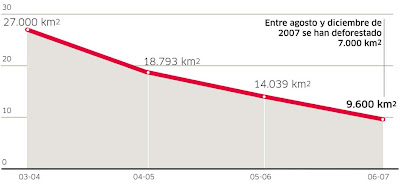
La Amazonía, considerada el pulmón del planeta, tiene una extensión de 4,1 millones de kilómetros cuadrados que albergan más de un tercio de todas las especies existentes en el mundo, y su rápida deforestación es motivo de preocupación para instituciones y organizaciones ambientales.

Un informe reciente del Instituto Nacional de Pesquisas Espaciales (INPE), apuntaba a una reducción en la deforestación de esta gigantesca selva en un 42% respecto al año 2009, siguiendo una tendencia a la baja que ya se venía observando desde el 2004.

Fuente: El Mundo

José

viernes, 3 de septiembre de 2010

Fronteras: La Maldición de Anacoco


1.La Isla de Anacoco en 1966, en un primer plano el caño "Brazo Negro" que se desprende del cauce principal del río Cuyuni, al centro las instalaciones de la G.N. y al fondo una línea que señala el río Cuyuní (cauce principal) que fluye al Este y que delinea la línea de facto, . Archivo de la Fundación de la Guayana Esequiba. texto corregido el 12-09-2010

2. La línea Esequiba o línea de facto

3. Ubicación des Isla de Anacoco

Tomado de:

Frontiers: The curse of Ankoko

Posted By Stabroek staff On August 31, 2010 @ 5:03 am In Guyana Review

Venezuela’s illegal occupation of Ankoko Island has poisoned relations with Guyana for 44 years.

President Bharrat Jagdeo’s official visit to Venezuela last July was long on the economy and short on a strategy to resolve the thorny territorial controversy between the two neighbours. As President’s Cheddi Jagan discovered when he met President Rafael Caldera in October 1995 and as President Janet Jagan learnt on her July 1998 visit to Caracas, the territorial controversy is not a matter for the uninformed and inexperienced.

As soon as the last British troops left Guyana in October 1966 – Guyana’s independence year – the Venezuelan National Armed Forces seized the 7-km² Ankoko Island in the Cuyuni River. It has remained in illegal occupation ever since. The island is used as a military garrison to harass Guyanese miners and to engage in occasional acts of provocation against the Guyana Defence Force border detachment at Eteringbang on the opposite bank of the river. But the symbolism of the occupation of Ankoko has been a bone in the throat of Guyanese negotiators ever since and has intoxicated Venezuela’s diplomats with delusions of superiority.

Venezuelan leaders seem to derive satisfaction from the simmering dispute and evince no interest in attempting a solution. In the hands of President Hugo Chávez Frías and his successive ministers of external relations, the territorial issue has become a useful instrument of ‘finlandisation.’ Through veiled threats and subtle pressures and small concessions about commodities, Venezuela has sought to establish itself as the arbiter of Guyana’s development of the entire Essequibo that it still refers to as its zona en reclamación. Weak Guyanese diplomats and ministers seem to satisfied with their impotence.

The most brazen example of that policy was President Chávez’s angry opposition to the proposed Beal Aerospace Technologies project in the Barima-Waini Region a decade ago in 2000. President Chávez at that time intervened personally to destroy the agreement between the Government of Guyana and Beal Aerospace Technologies Inc which aimed at establishing a satellite launch station in the Barima-Waini Region.

He suggested implausibly that that the planned station would be a ‘Trojan horse’ that threatened Venezuela’s security by enabling the United States to establish a ‘military base’ along his country’s vulnerable eastern flank. President Jagdeo met President Chávez at a conference of South American leaders in Brasilia shortly afterwards and pleaded, “I gave him a copy of the contract so that he could see for himself that there is no intention, or anything written into it, that would allow the establishment of an American base.” Alas, to no avail. Chávez’s pugnacity prevailed.

President Chávez who entered office in 1998 and was re-elected in 2000 and 2006 has become familiar with the style and strengths of President Jagdeo who entered office in 1999 and was re-elected in 2001 and 2006. As if by mutual agreement, they make little mention of the sovereignty question. There are two exceptions, though.

One is the UN Good Officer process. Both presidents ritually reaffirm their confidence in the United Nations Secretary General Good Offices Process as a mechanism that would assist the parties to advance towards a practical and satisfactory solution for the border issue, without affecting good bilateral and regional relations. Both Presidents, on the occasion of Mr Jagdeo’s latest visit, welcomed the appointment of, and expressed their confidence in, the work of Professor Norman Girvan as the Personal Representative of the United Nations Secretary General responsible for the Good Offices Process. President Jagdeo announced the designation of the Honourable Ralph Ramkarran as Guyana’s Facilitator and President Chávez announced the designation of Ambassador Roy Chaderton as the Facilitator for Venezuela.

The other exception has not been so serene. Venezuelan administrations invariably seize every opportunity to iterate their doctrine of dominance over its smaller eastern neighbour, behaviour which it cannot display towards Colombia or Brazil.

Since his accession to office, President Hugo Chávez has made no attempt to conceal his personal posture on Venezuela’s territorial claim. During his state visit to Guyana in February 2004, he told the press plainly that his administration would have no objection to such infrastructure as roads, water and electricity that directly enhance the lives of residents. Strategically sensitive projects – including major offshore oil exploration ventures, mineral exploration or the involvement of foreign governments – were another matter. They should, he said, be discussed within the framework of the High-Level Bilateral Commission (Comisión Bilateral de Alto Nivel). President Chávez’s doctrine, in short, has been that Venezuela must have a role in determining the developmental destiny of Guyana’s Essequibo.

President Jagdeo, therefore, on his recent visit to Venezuela, stuck to advancing his economic agenda by small incremental steps as best he could. His visit, as a result, culminated in lots of low-level agreements. These include two memoranda of understanding between Guyana’s Ministry of Foreign Affairs and Venezuela’s Energy and Petroleum Ministry for the supply of fertilizer and fuel; a memorandum of understanding for the creation of a Committee for the Prevention, Investigation and Settlement of Fishing Incidents; a Letter of Commitment between Venezuela’s People’s Power for Food and Guyana’s Ministry of Agriculture and agreements for the increase of the supply of polished rice to Venezuela from 50,000 tonnes and paddy to 70,000 tonnes.

The possibilities of purchasing fertilizers, aviation fuel and Veniran tractors were also examined and it was agreed that Guyana will become an observer to the Bolivarian Alternative for the Americas. This could lead, possibly, to increase the volume of petroleum that Guyana could receive from Venezuela through the PetroCaribe facility.

In other discussions, President Chávez informed President Jagdeo of the recent approval of the necessary resources for carrying out the exercise of updating the hydrographical data of the Mahaica, Mahaicony and Abary rivers in Guyana, needed to execute the dredging works in cooperation with Venezuela. The Presidents discussed the Initiative for Integration of Regional Infrastructure of South America (IIRSA) initiative and reiterated their commitment to the realisation of its objectives.

They endorsed the proposal for a Guyana-Venezuela road link and agreed to seek, jointly, international resources to conduct the feasibility studies needed to implement this proposed project. The Presidents noted the importance of creating an environment to allow for the realisation of the economic potential of the areas that would be opened up as a result of the proposed road link agreeing to adopt policies and measures that would encourage economic activities to ensure the viability of the proposed road link. They mandated their respective Foreign Ministries to work on the convening of the High-Level Bilateral Commission to be held in Caracas.

President Jagdeo’s visit is over but it represents an opportunity missed and a road not taken. Agreements about rice, fertilizer, fuel and tractors and the like are important but do not necessarily require a state visit for their accomplishment. Strategic issues such as the territorial controversy require deeper thought. They cannot be postponed forever.

Venezuela’s claim extends over such a vast area of Guyana’s resources that it cannot be ignored by local or even global, policy-makers. Venezuela’s concerns about riverine pollution and environment degradation caused by Guyanese wild-west mining methods might have some foundation.The South American Initiative for Regional Infrastructural Integration might also transform Guyana’s hinterland and should also be given serious thought. Unlike the slothful attitude shown towards the road to Brazil, the road to Venezuela that is being planned from Ciudad Bolivar, across the Cuyuni-Mazaruni Region to Bartica and on to Linden and Suriname should be acted upon quickly. The menace of international narcotics-trafficking, gun-running, fuel-smuggling and trafficking in persons and measures to counter piracy, maritime poaching and illegal mining should not be avoided.

Much better could have been done to make the visit a diplomatic success. It is a pity that the Guyana side did not prepare better for such an important visit. Apart from the territorial issue, several other trans-border issues should be settled before they degenerate into forceful confrontations. Nobody wants conflict but pre-emptive agreement is needed to forestall worse problems.

Nota del editor del blog: Al referenciarse a la República Cooperativa de Guyana se deben de tener en cuenta los 159.500Km2, de territorios ubicados al oeste del río Esequibo conocidos con el nombre de Guayana Esequiba o Zona en Reclamación sujetos al Acuerdo de Ginebra del 17 de febrero de 1966.

Territorios estos sobre los cuales el gobierno Venezolano en representación de la Nación venezolana se reservo sus derechos sobre los territorios de la Guayana Esequiba en su nota del 26 de mayo de 1966 al reconocerse al nuevo Estado de Guyana .

“...por lo tanto, Venezuela reconoce como territorio del nuevo Estado, el que se sitúa al este de la margen derecha del río Esequibo y reitera ante la comunidad internacional, que se reserva expresamente sus derechos de soberanía territorial sobre la zona que se encuentra en la margen izquierda del precitado río; en consecuencia, el territorio de la Guayana Esequiba sobre el cual Venezuela se reserva expresamente sus derechos soberanos, limita al Este con el nuevo Estado de Guyana, a través de la línea del río Esequibo, tomando éste desde su nacimiento hasta su desembocadura en el Océano Atlántico...”

Fronteras: ¿Por qué debería confiar Guyana en Surinam?

Caricatura Tomada de:

Neighbours

Posted By Stabroek staff On September 3, 2010 @ 5:01 am In Business Cartoons |

Tomado de:

Frontiers: Why should Guyana trust Suriname?

Posted By Stabroek staff On August 31, 2010 @ 5:04 am In Guyana Review |

Suriname’s President Désiré Bouterse has an opportunity to change the course of Suriname’s relations with Guyana.

Mr Albert Ramdin, the Suriname-born Assistant Secretary General who led the delegation of the Organisation of American States to the inauguration ceremony, described the situation well. He explained that it was not a coincidence that no regional head of state attended the ceremonial inauguration of Suriname’s President Desire Delano Bouterse on August 12.

Mr Ramdin said that the leaders’ absence was understandable because “… it was not every day that a soldier who has led a coup is later democratically elected as president.” He added, “In the Americas some people are still hesitant about Bouterse. They still do not know how to deal with the situation in Suriname. Latin American and Caribbean countries will be looking to see how the policies of President Bouterse’s government unfold over the next six months.”

Guyana, Suriname’s nearest CARICOM neighbor, particularly will be interested in the manner in which President Bouterse’s policies unfold in the coming months. President Bharrat Jageo did not hesitate to congratulate Mr Bouterse soon after he was elected by the National Assembly in July. President Jagdeo wrote to President Bouterse wishing him “…every success as you embark upon the mandate conferred upon you by the Surinamese people…It is my hope that we can work together to further improve and deepen the relations between our two countries…I therefore, look forward to pursuing this desire with you for the mutual satisfaction and benefit of our peoples.”

Minister of Foreign Affairs Ms Carolyn Rodrigues-Birkett, when asked to comment, could say only that Guyana’s position was reflected President Jagdeo’s action in promptly sending a formal congratulatory message and in personally contacting the new Suriname President by telephone. Mr Jagdeo, however, as with other Heads of State the world over, did not extend his graciousness to attending Mr Bouterse’s inauguration. Guyana was represented by Prime Minister Samuel Hinds.

Apart from the international despondency expressed over Mr Bouterse’s election to office, it is a historical fact that diplomatic relations between Guyana and Suriname have always been difficult. A culture of cold courtesy, arising out of the territorial issue, has grown up over the past four decades. Suriname, as a result, has evinced little enthusiasm for improving relations with Guyana, even in the best of times.

Now that Mr Bouterse – widely considered to be a strong nationalist and rather hawkish territorial revanchist – has his hands on the levers of office again, cordial relations with Guyana are unlikely to be prominent on his scale of priorities. While the two neighbours have barely managed to maintain functional cooperation, Paramaribo has preferred bluster, bullying and blackmail and has always been disinclined to resort to international law over its claims to Guyana’s territory.

Georgetown, on the other hand, at least over the last 25 years, seems not to have grasped fully the fact that nothing else but the territorial claim matters to Suriname. During his first visit to Guyana, President Ronald Venetiaan crassly used the occasion of his address to the National Assembly on Guyana’s Independence Anniversary – 26 May 1995 – to express the seriousness with which Suriname viewed the border issue, saying that it “takes first place” in its relations with Guyana. The measured tone of his statements on the issue correctly explained his country’s intransigence and the reason why talks so often reach a stalemate.

Despite President Venetiaan’s conviction, he was criticised by the opposition parties at the time for his alleged appeasement of Guyana. The National Democratic Party was among those that boycotted President Bharrat Jagdeo’s formal address to the National Assembly on 29th January 2002 during his official visit.

Suriname’s officials do not conceal their negative perceptions and unfavourable stereotypes of Guyanese officials. Georgetown, for its part, does little to dispel doubts about its policies. Its failure to craft a coherent frontiers policy; its weak diplomatic representation in Paramaribo and refusal to adopt a more assertive diplomatic posture have placed it in an unequal and unfavourable relationship with Paramaribo. Its reliance on party hacks where professional diplomatic representation is needed and the supine posture of Guyanese officials who do little to suppress illegalities such as back-tracking, contraband-smuggling, illegal fishing and piracy across the Corentyne River have eroded official credibility. The uninformed positions of its untrained political negotiators who misunderstand the territorial problem have contributed to Suriname’s disdain for the Guyana Government.

These perceptions are reflected in Suriname’s impertinent treatment of Guyanese nationals resident in that country. It is manifested in the official harassment and arrest of Guyanese fishermen, seizure of their fishing vessels and imposition of heavy fines. These have all been expressions of an administrative culture of unfriendliness.

The chronicle of diplomatic relations tells a tale of disdain and distrust. The establishment of the Guyana-Suriname Cooperation Council to concretise relations did not take place until May 1986. It then took three years for the inaugural meeting of the Council to be held in July 1989. Scheduled meetings of the Cooperation Council have been deliberately derailed by Suriname’s insistence on raising its territorial claim against Guyana, a matter which should properly be addressed through the Guyana-Suriname Border Commission. Events such as these set the tempo of dilatoriness and indecisiveness in bilateral relations.

The Guyana-Suriname Anti-Narcotics Agreement was signed in July 1989, for example, but was not ratified until five years later, in June 1994. Discussions on fisheries cooperation have been slowed by Suriname’s insistence on exorbitant levies for licences for Guyanese fishermen operating in the Corentyne River and off the Atlantic Coast. Agreements to cooperate in the development of bauxite, gold, petroleum and hydro-power and have not been worth the paper on which they were written. Agreements for agricultural, commercial, economic and technical co-operation in the fields of fisheries, health, forestry, air services have yielded unsatisfactory results. Fitful meetings between officials of the University of Guyana and Suriname’s Anton de Kom University have dissolved into inertia.

Much of the formal diplomatic contact between Guyana and Suriname has actually occurred at the consular level. It centred around Suriname’s propensity to occasionally arrest, ill-treat and imprison Guyanese fishermen operating in the Corentyne River and the way that problems associated with the large Guyanese resident community are handled.

Guyana must be concerned also, at the continental level, that President Bouterse will seek to strengthen the traditional Suriname-Venezuela entente cordiale that was employed to isolate Guyana in the 1970s and 1980s. Mr Bouterse’s Suriname could become a candidate to join the Venezuelan President Hugo Chavez’s ‘Twenty-First Century Socialism” movement that has taken root in some Andean states. President Désiré Bouterse, in his salad days, used to profess adherence to some form of socialism.

The USA has been apprehensive about President Bouterse’s election. Washington’s historic interventionist role in the Circum Caribbean – the 1965 invasion of the Dominican Republic; the 1983 invasion of Grenada; the 1981-1990 destabilisation of Nicaragua; the 1989 invasion of Panama and, most recently, the 2004 regime change in Haiti, a CARICOM member state, when the democratically elected President Jean-Bertrand Aristide was forced out of office in 2004 – will not be forgotten in the hemisphere.

Suriname is also still perceived as an export platform for illegal narcotics to Europe. Surinamese drug cartels are suspected of having negotiated with Colombia’s terrorist rebel movement – the Fuerzas Armadas Revolucionarias de Colombia – in guns-for-drugs transactions. Narcotics-trafficking and everyday contraband-smuggling would likely continue or increase and other crimes could go unpunished. The free movement of persons that will be facilitated by the fact that Suriname is a member of CARICOM and, therefore, the Caribbean Single Market and Economy, could put the Guyana-Suriname border on the Corentyne River further under stress.

Guyana’s relations with Suriname are very important not only to the two states themselves but also to CARICOM, the OAS, UNASUR and other regional organisations.

President Bouterse inauguration could move bilateral relations either forwards or backwards. The quality of the statesmanship he evinces and the level of the leadership he gives to his ministers and officials will determine the direction of Guyana-Suriname relations and whether he is a trustworthy ally in regional development.

miércoles, 1 de septiembre de 2010

Crecerá el Impacto Ambiental en la Guayana Esequiba por venta de Combustible venezolano


Oscar J. Márquez

Indudablemente que la venta y suministro de combustible para aeronaves jp-5 y jp-8, (jet fuels jp-5 and jp-8) a la Republica Cooperativa de Guyana como bien señala la información de la prensa beneficiará posiblemente la creación de líneas aéreas y contribuirá con su desarrollo económico en detrimento de Venezuela.

A su vez impactara el medio ambiente de los territorios ubicados al oeste del río Esequibo conocido como la Guayana Esequiba que abarcan unos 159.500 km cuadrados de territorios y que la nación venezolana aspira reivindicar mediante una solución justa y practica según lo establecido en el Acuerdo de Ginebra a la cual los dirigentes guyaneses se han opuesto pretendiendo ganar tiempo y su olvido.

La venta de combustible jp-5 y jp-8, a Guyana viola la actual Constitución Nacional aprobada en una Asamblea Nacional Constituyente auspiciada y promovida por el actual mandatario venezolano.

Además este suministro de combustible jp-5 y jp-8, afecta las aspiraciones, objetivos e intereses nacionales en razón que parte de este combustible será desviado para ser utilizado en las aeronaves de ala fija y rotatoria encargadas de la logística para la explotación de oro y diamante no solamente en los 06 Distritos Mineros y las minas de Aranka y Aurora así como en aéreas de explotación de minería ilegal. Beneficiando con los bajos precios del combustible a las transnacionales encargadas de la explotación del oro y el diamante aumentando sus exorbitantes ganancias.

Este suministro de combustible a Guyana contradice las actuales políticas del gobierno venezolano a través de su Plan Caura que señalan textualmente: “…detrás de la extracción ilegal de oro y otros minerales se encuentran mafias transnacionales y oligarquías locales quienes esclavizan a indígenas y campesinos, sujetos a esa maquinaria de aprovechamiento indiscriminado de las riquezas…”.

Situación esta que no es distinta de la venezolana en Guyana y la Zona en Reclamación, no es un secreto para nadie según cifras de la Comisión de Geología y Minas de Guyana (GGMC) y la Asociación de Mineros de Guyana (GGDMA) entre Guyana y la Guyana Esequiba o Zona en Reclamación existen cerca de diez mil mineros ilegales brasileños conocidos como Garimpeiros así como otro tanto de guyaneses dedicados a esta actividad que viven en la costa y solo se trasladan al interior a la explotación.

Además el gobierno guyanés ante su desbalance en su balanza de pagos necesita aumentar como bien lo señalo en el pasado mes de febrero El Dr. Ashni Sing, Ministro de finanzas de Guyana de un crecimiento del 4% en las declaraciones de las ventas del oro por parte de los explotadores independientes de unas 311.816 onzas este año, significativamente menor a las 500.000 onzas a declarar por la industria. Cifras estas que según los entendidos en la, materia es mayor para evadir los impuestos. Además de que parte del oro y diamantes declarados en Guyana provienen de Venezuela.

Por otra parte la ciencia nos señala que solo se obtienen unos cuantos gramos o onzas por tonelada de tierra removida y lavada acida (por el mercurio y cianuro) que va a ingresar a los arroyos y ríos sedimentándolos por kilómetros afectando los diferentes ecosistemas.

Por lo tanto los funcionarios públicos venezolanos que han participado de alguna manera en este tipo de negociaciones. En referencia a la venta y suministro de combustible jp-5, jp-8, y otros a Guyana, como lo hemos señalado en otras oportunidades no escapan de cometer un delito contra la integridad territorial venezolana, por su responsabilidad penal civil y administrativa en sus actuaciones al no dejar sentados los derechos de Venezuela y condicionar la utilización del referido combustible.